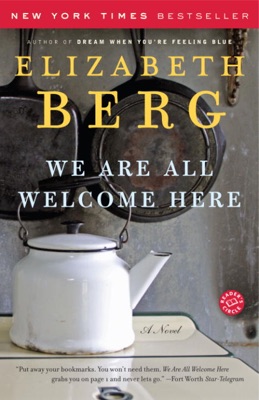
Elizabeth Berg, bestselling author of The Art of Mending and The Year of Pleasures, has a rare talent for revealing her charactersâ hearts and minds in a manner that makes us empathize completely. We Are All Welcome Here features three women, each struggling against overwhelming odds for her own kind of freedom.
It is the summer of 1964. In Tupelo, Mississippi, the town of Elvisâs birth, tensions are mounting over civil-rights demonstrations occurring ever more frequentlyâand violentlyâacross the state. But in Paige Dunnâs small, ramshackle house, there are more immediate concerns. Challenged by the effects of the polio she contracted during her last month of pregnancy, Paige is nonetheless determined to live as normal a life as possible and to raise her daughter, Diana, in the way she sees fitâwith the support of her tough-talking black caregiver, Peacie.
Diana is trying in her own fashion to live a normal life. As a fourteen-year-old, she wants to make money for clothes and magazines, to slough off the authority of her mother and Peacie, to figure out the puzzle that is boys, and to escape the oppressiveness she sees everywhere in her small town. What she can never escape, however, is the way her life is markedly different from othersâ. Nor can she escape her ongoing responsibility to assist in caring for her mother. Paige Dunn is attractive, charming, intelligent, and lively, but her needs are greatâand relentless.
As the summer unfolds, hate and adversity will visit this modest home. Despite the difficulties thrust upon them, each of the women will find her own path to independence, understanding, and peace. And Dianaâ s mother, so mightily compromised, will end up giving her daughter an extraordinary gift few parents could match.
Elizabeth Berg, bestselling author of The Art of Mending and The Year of Pleasures, has a rare talent for revealing her charactersâ hearts and minds in a manner that makes us empathize completely. We Are All Welcome Here features three women, each struggling against overwhelming odds for her own kind of freedom.
It is the summer of 1964. In Tupelo, Mississippi, the town of Elvisâs birth, tensions are mounting over civil-rights demonstrations occurring ever more frequentlyâand violentlyâacross the state. But in Paige Dunnâs small, ramshackle house, there are more immediate concerns. Challenged by the effects of the polio she contracted during her last month of pregnancy, Paige is nonetheless determined to live as normal a life as possible and to raise her daughter, Diana, in the way she sees fitâwith the support of her tough-talking black caregiver, Peacie.
Diana is trying in her own fashion to live a normal life. As a fourteen-year-old, she wants to make money for clothes and magazines, to slough off the authority of her mother and Peacie, to figure out the puzzle that is boys, and to escape the oppressiveness she sees everywhere in her small town. What she can never escape, however, is the way her life is markedly different from othersâ. Nor can she escape her ongoing responsibility to assist in caring for her mother. Paige Dunn is attractive, charming, intelligent, and lively, but her needs are greatâand relentless.
As the summer unfolds, hate and adversity will visit this modest home. Despite the difficulties thrust upon them, each of the women will find her own path to independence, understanding, and peace. And Dianaâ s mother, so mightily compromised, will end up giving her daughter an extraordinary gift few parents could match.